
NHS Nurses Pay Rise 2026/27: Latest Pay Bands, Band 5 Review And 2027/28 Update
 • February 14, 2026

The NHS nurses pay rise for 2026/27 is confirmed at 3.3% for Agenda for Change staff in England, effective from 1 April 2026.
Nurses have already moved onto the updated pay scales, while attention is increasingly turning towards Band 5 job reviews, wider Agenda for Change reform and the next NHS pay round for 2027/28.
The position is therefore no longer simply about whether nurses will receive a rise. Several important changes are now running alongside the annual award, including reviews of Band 5 nursing roles and negotiations that could influence pay beyond 2026/27.
NHS Nurses Pay Rise 2026 At A Glance:
Pay Issue 2026 Position
Agenda for Change Pay Rise 3.3%
Effective Date 1 April 2026
England Band 5 Salary £32,073 to £39,043
Band 5 Review Underway
Band 5 Review Target October 2028
Separate Nursing Pay Spine Not Being Taken Forward
2027/28 Pay Round Officially Started
2027/28 Pay Rise Percentage Not Yet Confirmed
The 3.3% award is consolidated, meaning it increases the underlying salary rather than being paid as a one-off bonus.
NHS staff covered by Agenda for Change can check the updated annual, hourly and London supplement figures in the official NHS Employers 2026/27 pay scales, which took effect from 1 April 2026.
Last Updated: 16.09.2026
Has The NHS Nurses Pay Rise Been Confirmed For 2026?
Yes. Nurses and other qualifying Agenda for Change staff in England received a 3.3% consolidated increase for 2026/27.
The award was announced in February 2026 and became effective on 1 April. It was also implemented significantly earlier than many previous NHS awards, with the updated rates going into April salaries.
The increase covers much more than registered nurses because Agenda for Change is the national pay structure used for a large proportion of the NHS workforce.
Who Is Eligible For The 3.3% NHS Pay Rise?
The 3.3% increase applies to employees working under Agenda for Change terms in England.
Staff covered can include:
- Registered Nurses And Midwives
- Healthcare Assistants And Nursing Support Staff
- Paramedics And Ambulance Staff
- Physiotherapists And Other Allied Health Professionals
- Administrative And Clerical Employees
- Porters, Estates And Support Staff
Doctors, dentists and very senior managers generally operate under separate national pay arrangements rather than the standard Agenda for Change structure.
What Are The NHS Pay Bands For 2026/27?
The updated England pay scales show how the 3.3% increase translates into annual salaries.
Band Entry Intermediate Top
Band 2 £25,272 — £25,272
Band 3 £25,760 — £27,476
Band 4 £28,392 — £31,157
Band 5 £32,073 £34,592 £39,043
Band 6 £39,959 £42,170 £48,117
Band 7 £49,387 £51,932 £56,515
Band 8a £57,528 £60,417 £64,750
Band 8b £66,582 £70,896 £77,368
Band 8c £79,504 £84,346 £91,609
Band 8d £94,356 £100,140 £108,814
Band 9 £112,782 £119,583 £129,783
Not every band has three pay points. Progression within a band also depends on the Agenda for Change pay progression arrangements rather than simply occurring automatically each year.
How Much Will Band 5 Nurses Earn In 2026?
Band 5 is particularly important because many newly registered NHS nurses enter at this level.
For 2026/27 in England:
Band 5 Position Annual Salary Hourly Rate
Entry £32,073 £16.40
Intermediate £34,592 £17.69
Top £39,043 £19.97
These are standard England rates before applicable High-Cost Area Supplements or other additions such as unsocial-hours payments.
The annual 3.3% increase means a Band 5 nurse receives a higher basic salary throughout the year, although the change in actual take-home pay will depend on income tax, National Insurance, NHS pension contributions and any student loan deductions.
What Will London NHS Nurses Earn In 2026?
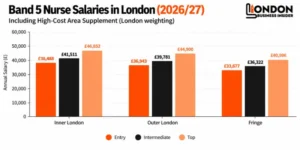
Nurses working in eligible London locations can receive a High-Cost Area Supplement, commonly known as London weighting.
For a Band 5 nurse, the 2026/27 rates are:
Location Entry Intermediate Top
Inner London £38,488 £41,511 £46,852
Outer London £36,943 £39,781 £44,900
Fringe £33,677 £36,322 £40,996
Inner London HCAS is generally calculated at 20% of basic salary within minimum and maximum limits. Outer London uses 15%, while the Fringe rate is 5%, again subject to applicable limits.
This means two nurses at the same pay point can have different total salaries depending on where their NHS post is based.
How Does NHS Nurses Pay Differ Across The UK?
There is no single identical nursing settlement covering every part of the UK.
Nation 2026/27 Position
England 3.3% Agenda for Change uplift
Wales 3.3% AfC uplift, with larger increases for some lowest-paid staff
Scotland 3.75% under its two-year agreement
Northern Ireland Separate local implementation and funding arrangements
Scotland’s settlement forms part of a two-year agreement covering 2025/26 and 2026/27. The Scottish Government states that the 2026/27 increase is 3.75%, while its agreement also contains an inflation-related guarantee.
Wales accepted the 3.3% NHS Pay Review Body recommendation from 1 April 2026, but its Real Living Wage policy means certain lower-paid NHS employees receive increases of between 3.8% and 5.9%.
Is The NHS Nurses Pay Rise Above Inflation?
Whether the 3.3% award ultimately represents a meaningful real-terms improvement depends on how inflation develops throughout the financial year.
A nurse can receive a higher cash salary but still experience pressure on household finances if housing, food, transport, energy and other costs rise quickly.
It is therefore better to distinguish between two things:
- Nominal Pay: Nurses are receiving higher basic salaries in 2026/27.
- Real Pay: The improvement in purchasing power depends on inflation over the relevant period.
This distinction is important because comparing the annual pay award with one month’s inflation figure does not establish what nurses will experience over the entire year.
How Has The NHS Nurses Pay Rise Changed Nurses’ Lives?
The most immediate difference is financial certainty.
Nurses entered the 2026/27 financial year knowing the new salary rates rather than waiting months for an award to be implemented retrospectively.
For a Band 5 nurse, the increase raises gross annual earnings by roughly £1,000 or more depending on the pay point.
Staff working unsocial hours can also see associated payments change where those payments are calculated using the revised basic hourly rate.
However, the effect on daily life differs considerably between employees.
A nurse with high housing costs, childcare expenses or commuting costs may experience the increase differently from someone with lower household outgoings.
Pension contributions, tax and student loan repayments can also mean the increase visible in take-home pay is smaller than the headline gross salary change.
The 2026 award therefore provides additional income, but it does not by itself settle wider concerns about workload, career progression, staffing levels or whether experienced nurses are correctly banded for the responsibilities they perform.
What Are Nursing Unions Saying About The 2026 Pay Rise?
Nursing and health unions have continued to focus on both the value of the annual award and deeper problems within the Agenda for Change structure.
A major issue is whether nurses’ responsibilities have increased without their job descriptions and pay bands keeping pace.
There is also disagreement over how nursing career progression should work.
The RCN has supported more nursing-specific changes, while other organisations have argued that reforms to Agenda for Change should benefit the wider NHS workforce.
The debate is therefore increasingly moving beyond the headline 3.3% NHS nurses pay rise towards how nurses progress between bands and how jobs are evaluated.
What Is Happening With The Band 5 Nursing Review?
One of the biggest developments of 2026 is the national review of Band 5 nursing roles directly employed by NHS trusts in England.
NHS England instructed organisations to develop delivery plans showing how their Band 5 nursing roles will be reviewed.
The official NHS England Band 5 job evaluation guidance sets a target for all relevant Band 5 nursing roles to be reviewed by October 2028.
The purpose is to determine whether nurses’ existing job descriptions accurately reflect the work they actually perform and whether the correct Agenda for Change band has been applied.
Trusts were expected to submit their delivery plans by 31 July 2026.
Will Band 5 Nurses Automatically Move To Band 6?
No. The Band 5 review does not mean every Band 5 nurse will automatically become Band 6.
NHS England makes clear that any change depends on the duties attached to the role and the proper application of the NHS Job Evaluation Scheme.
Employers remain responsible for individual job evaluation decisions.
A role could remain at Band 5 if its responsibilities are correctly evaluated at that level.
Where evaluation establishes that a role carries greater responsibility and should sit in another band, the employer must deal with the outcome through the established job-evaluation process.
This distinction matters because proposals for more automatic progression from Band 5 have been discussed by nursing representatives, but they are not the same thing as the confirmed national Band 5 review.
Is A Separate NHS Pay Spine Coming For Nurses?
A completely separate national nursing pay spine is not currently being introduced.
The government considered the proposal but decided in April 2025 not to take it forward.
Its consultation response said career-progression problems identified by nurses were also experienced by other Agenda for Change professions and highlighted equal-pay and legal risks from separating nursing pay.
Instead, the current approach focuses on reforming Agenda for Change, improving job evaluation, examining graduate pay and reviewing Band 5 nursing roles.
The government’s consultation also showed significant support for change among nurses who responded.
Of the nurses answering the relevant question, 94% said they believed a separate nursing pay spine would improve career progression and professional development.
That means the separate-spine proposal itself has been rejected, but many of the concerns behind it remain central to the current pay reform debate.
Do General Practice Nurses Get The Same NHS Pay Rise?
Not necessarily. General practice nurses are frequently employed directly by GP practices rather than NHS trusts.
This means they should not automatically assume that the Agenda for Change 3.3% increase applies to their salary in exactly the same way as it does to an NHS trust employee.
Their pay depends on their employment arrangements, contract and the decisions made by their employer.
A nurse working in general practice should therefore check their employment contract and speak to their practice employer rather than relying solely on the national Agenda for Change pay table.
NHS Nurses Pay Rise Timeline: From Introduction To Future Changes
Period Development
2025 Government decides not to introduce a separate nursing pay spine
February 2026 3.3% Agenda for Change award announced
1 April 2026 New 2026/27 pay rates take effect
April 2026 Agenda for Change structural negotiations begin
June 2026 Detailed Band 5 nursing review programme published
July 2026 Trust Band 5 review delivery plans due
15 July 2026 2027/28 NHS pay round formally begins
Autumn 2026 Government evidence for the 2027/28 pay round expected
2026–2028 Band 5 nursing reviews continue
October 2028 Target for completing Band 5 nursing role reviews
The timeline shows how NHS nursing pay is shifting from a single annual percentage increase towards a wider programme covering job evaluation, graduate pay, career progression and potentially longer-term pay settlements.
What Is Happening With The NHS Nurses Pay Rise For 2027/28?
The next NHS pay round has already started, but there is no confirmed 2027/28 nursing pay percentage yet.
The Department of Health and Social Care formally opened the process on 15 July 2026.
Its 2027/28 NHS Pay Review Body remit letter states that departmental evidence will be provided during autumn 2026 and will cover available funding, recruitment and retention, earnings data and wider NHS strategy.
The government has also asked for the process to move more quickly so the eventual 2027/28 award can be announced in a timely way.
Until the Pay Review Body process progresses and a government decision is announced, figures circulating for the next NHS nurses pay rise should be treated as estimates rather than confirmed rates.
Latest NHS Nursing Pay Talks Update – September 2026
As of September 2026, the important point is that two processes are running alongside each other.
The first is the normal NHS Pay Review Body process for 2027/28.
The second is the wider negotiation over the Agenda for Change pay structure.
The NHS Staff Council confirmed in April that it had received a mandate from the governments of England, Wales and Northern Ireland to negotiate structural reform.
Those negotiations were designed to consider long-standing problems within Agenda for Change, including graduate pay and other structural issues.
Crucially, the July 2026 government remit letter confirmed that the negotiating mandate has the potential to include headline pay uplifts for 2027/28 and 2028/29.
That does not mean a two-year pay deal has already been agreed. It means a multi-year arrangement remains one possible outcome of the negotiations.
Confirmed Vs Unconfirmed NHS Nursing Pay Changes
Development September 2026 Status
3.3% 2026/27 AfC Pay Rise Confirmed
2026/27 England Pay Scales Confirmed
Band 5 Nursing Review Underway
October 2028 Band 5 Review Target Confirmed
Separate Nursing Pay Spine Not Being Taken Forward
Automatic Band 5 To Band 6 Progression Not Confirmed
Agenda For Change Structural Reform Under Negotiation
2027/28 Pay Review Underway
2027/28 Pay Percentage Not Yet Confirmed
Combined 2027/28 And 2028/29 Deal Possible, But Not Agreed
This distinction is particularly important because proposals, union demands and active negotiations can easily be mistaken for confirmed changes.
What Happens Next For NHS Nurses’ Pay?
The NHS nurses pay rise story will continue well beyond the 3.3% award.
During the remainder of 2026, attention will centre on government and workforce evidence for the 2027/28 pay round, negotiations over Agenda for Change reform and the implementation of Band 5 reviews at NHS trusts.
If structural negotiations result in an agreement, some reforms have been designed to take effect from or be backdated to 1 April 2026, depending on the terms ultimately agreed.
The talks can also potentially extend into headline pay arrangements for 2027/28 and 2028/29.
For nurses, the most important developments to watch are therefore not only the next headline percentage but also graduate pay, job evaluation, Band 5 responsibilities and whether a longer-term pay settlement emerges.
Conclusion
The NHS nurses pay rise for 2026/27 is confirmed at 3.3% for Agenda for Change staff in England, with the new rates effective from 1 April 2026.
A standard Band 5 salary now ranges from £32,073 to £39,043, with higher totals available in eligible London locations.
The bigger story in the second half of 2026 is structural change. Band 5 nursing roles are being reviewed, Agenda for Change reform negotiations are underway and the 2027/28 pay round officially started in July.
There is currently no confirmed percentage for 2027/28 and no agreement guaranteeing automatic Band 5-to-Band 6 progression.
Nurses should therefore distinguish between changes already implemented, reforms that are being negotiated and proposals that have not yet become national policy.
FAQs About NHS Nurses Pay Rise 2026
When Did The 3.3% NHS Pay Rise Start?
The 3.3% Agenda for Change increase took effect from 1 April 2026 in England. Updated rates were implemented in April salaries.
How Much Does A Band 5 Nurse Earn In 2026?
A Band 5 nurse in England earns between £32,073 and £39,043 in basic annual pay for 2026/27. London High-Cost Area Supplements can increase the total salary.
Will Band 5 Nurses Move To Band 6?
Not automatically. Each role must be assessed through the job-evaluation process, and any rebanding depends on the actual duties and responsibilities attached to that role.
Is There Another NHS Nurses Pay Rise Coming In 2027?
The 2027/28 pay review has begun, but no percentage has yet been confirmed. The government formally launched the next Pay Review Body process on 15 July 2026.
Are London Nurses Paid More?
Eligible London NHS employees receive High-Cost Area Supplements. The amount differs between Inner London, Outer London and Fringe areas.
Do GP Nurses Get The 3.3% Pay Rise?
Not automatically. Many general practice nurses are directly employed by GP practices, so their salary increase depends on their individual employment arrangements.
Is The Separate Nursing Pay Spine Still Going Ahead?
No. The government decided in 2025 not to proceed with a separate national nursing pay spine. Current work instead focuses on Agenda for Change reform, job evaluation, Band 5 reviews and graduate pay.