

Civil Service Pay Rise 2026: 3.5% Remit, Department Offers and Latest Updates
 • March 12, 2026
•
1 Comment
• March 12, 2026
•
1 Comment

Last updated: 2 October 2026
The civil service pay rise 2026 is based on a maximum 3.5% Increase to Remuneration Cost, or IRC, for most departments covered by the 2026/27 delegated pay framework. However, 3.5% is not an automatic individual salary increase.
Departments can decide how to distribute their available pay budget according to workforce pressures, grade structures, recruitment problems and wider business priorities.
That means some employees may receive more than 3.5%, others may receive less, and certain departments can follow separate multi-year or exceptional arrangements.
The position has also moved considerably since the national framework was published in May.
Departmental offers are now emerging, the Home Office is operating under a multi-year agreement, HMRC has published an offer that has been rejected by its largest recognised union, and some employees are still waiting for final implementation details.
What Is Confirmed About the Civil Service Pay Rise 2026?
For the 2026/27 pay year, the headline IRC is set at a maximum of 3.5%.
IRC measures the overall change in a department’s remuneration costs rather than the percentage added to each employee’s salary. For example, if proposals add £200,000 to a baseline remuneration cost of £20 million, the IRC is 1%.
Departments therefore have flexibility over how the 3.5% is distributed. Pay-band changes, allowances, restructuring and some other employment costs can all affect the calculation.
The standard delegated framework also does not cover organisations already operating under approved arrangements extending into 2026/27.
What Are Departments Offering Civil Servants in 2026/27?
The national remit is only the starting point. Actual pay outcomes depend on individual departments.
DWP No new confirmed department-wide 2026/27 settlement has been identified in the public information reviewed for this update.
| Department or Workforce | Latest 2026/27 Position |
|---|---|
| HMRC | Base-pay increases in the current offer range from 3.30% to 4.43%, depending on grade and location. The package also contains changes involving working hours, overtime, allowances, parental leave and a performance-related pay trial. The main recognised union's executive rejected the package on 22 September, with member meetings scheduled during October. |
| Home Office | Staff covered by the accepted three-year arrangement have a guaranteed minimum 5.5% uplift for 2026/27, following at least 6% for 2025/26 and before a minimum 4% in 2027/28. Actual outcomes can differ by grade and location. |
| DWP | No new confirmed department-wide 2026/27 settlement has been identified in the public information reviewed for this update. Employees should therefore use current departmental communications rather than applying the 3.5% headline directly to their salary. |
| Defence Equipment & Support | Implementation has been unusually slow. Reports in August said the agency was not expecting the 2026/27 increase to reach employees until the early part of 2027, while discussions over the award continued. |
| Operational prison staff in England and Wales | A separate pay-review arrangement applies. Eligible operational staff received at least 3.5%, effective from 1 April 2026, with additional progression arrangements for some grades. |
This shows why the civil service pay rise cannot be treated as one universal percentage applying identically across Whitehall and its agencies.
How Much Would a 3.5% Pay Rise Be Worth?
Civil Service pay below senior grades is delegated, so there is no single national salary scale covering every department.
Official workforce statistics show that the median Civil Service salary was £37,820 at 31 March 2026. Median pay ranged from £28,020 across AA/AO administrative grades to £95,540 at Senior Civil Service level.
The figures below simply illustrate what a full 3.5% increase would look like if applied directly to current service-wide median salaries.
| Grade Group | 2026 Median Salary | Illustrative 3.5% Increase | Illustrative New Salary |
|---|---|---|---|
| AA / AO | £28,020 | £981 | £29,001 |
| EO | £32,140 | £1,125 | £33,265 |
| HEO / SEO | £43,930 | £1,538 | £45,468 |
| Grade 6 / Grade 7 | £65,830 | £2,304 | £68,134 |
| Senior Civil Service | £95,540 | £3,344 | £98,884 |
These are examples, not departmental salary scales or guaranteed awards. The Senior Civil Service also has a separate centrally managed 2026/27 pay framework.
When Will the Civil Service Pay Rise Be Paid?
There is no single payment month for all departments.
Each organisation has its own pay settlement date and implementation timetable. The rules allow departments to seek approval to move their settlement date to 1 April, which is intended to create greater consistency between organisations.
Importantly, implementing an award later does not automatically reduce its IRC value. Where an award applies retrospectively from the settlement date, employees may receive arrears when the new rate reaches payroll.
A large backdated payment can make one month’s payslip look significantly different because tax, National Insurance, pension contributions, student loan repayments or benefit calculations may also be affected. Employees should therefore compare the payment with their department’s award notice before assuming a deduction is incorrect.
How Could the Pay Rise Affect Civil Service Pension Contributions?
Gross pay increases can also affect pension deductions.
For 2026/27, member contribution rates for the main Civil Service pension schemes are:
| Annual Pensionable Earnings | Employee Contribution |
|---|---|
| Up to £36,199 | 4.60% |
| £36,200 to £56,000 | 5.45% |
| £56,001 to £150,000 | 7.35% |
| £150,001 and above | 8.05% |
Employees close to £36,200 or £56,001 should therefore check whether a salary increase moves their pensionable earnings into a different contribution band.
Those already following wider pension-administration issues may also want the latest update on the Civil Service pension scheme modeller delay.
What Is Happening With Low Pay and Pay Compression?
Pay compression happens when salaries for different grades move increasingly close together. It has become particularly important around AA, AO and EO grades as statutory wage floors have risen.
The 2026/27 framework allows departments with significant compression problems to submit additional business cases.
The costs can sit above the headline remit if approved, although departments must fund the reform within their existing spending envelopes and meet specified workforce-reform conditions.
Workforce representatives involved in the national discussions have described the intended approach as restoring differentials of around 5% between AA and AO and another 5% between AO and EO.
This should not be confused with the additional 0.5% low-pay flexibility used in 2025/26. The structure for 2026/27 is different.
The issue has become more significant since the introduction of the latest 2026 minimum wage rates, because rising statutory pay floors can quickly narrow the difference between junior Civil Service grades.
Are Digital and Specialist Staff Getting an Extra 1%?
Not automatically.
Two separate flexibility arrangements need to be distinguished.
A small-scale targeted workforce business case can cover fewer than 500 full-time-equivalent employees and seek an additional IRC of less than 1% above the headline remit for that particular group. These cases can normally use a streamlined official-level approval process.
Separately, the Government Digital, Data and Cyber Pay Framework allows approved capability-based allowances for difficult-to-recruit digital, data and cyber roles.
Those allowances are funded outside the headline pay remit, usually through savings such as reduced reliance on contractors. They do not count towards the IRC calculation.
The two arrangements are therefore not the same policy.
What Is Happening With Senior Civil Service Pay?
Senior Civil Service pay is managed separately from delegated AA to Grade 6 arrangements.
For 2026/27, senior civil servants received a 3.5% consolidated base-pay increase from 1 April 2026. A separate central pot worth 1% of the total Senior Civil Service paybill was also allocated for the introduction of pay progression.
That creates an important distinction between senior and delegated grades.
The delegated framework does not permit pay-flex proposals that create automatic time-served progression or entitlement to automatic annual increments.
What Does the 2026 Pay Rise Mean for Civil Servants in London?
London remains the largest individual regional location for the Civil Service.
At 31 March 2026, 107,810 civil servants worked in London, representing 19.4% of the workforce. London also has a considerably larger concentration of senior grades than areas outside the capital.
Regional pay therefore matters.
Under the Home Office multi-year arrangement, for example, the AO spot rate from July 2026 is £30,920 nationally, with the London rate set £4,000 higher.
HMRC’s current offer has also attracted objections over changes affecting the relative value of London pay.
London employees comparing departmental pay with wider earnings pressures can also look at the current London Living Wage yearly salary.
What Else Can Departments Include in Their Pay Plans?
The headline IRC can cover much more than a simple percentage increase to basic salary.
| Pay Element | How It Is Treated |
|---|---|
| Pay-band revaluation | Normally included in IRC |
| New or increased allowances | Normally included |
| Pay restructuring | Normally included |
| Non-performance lump sums | Generally included |
| Existing performance-payment pot | Normally outside IRC unless increased |
| Statutory National Living Wage adjustments | Can be funded outside the remit |
| Optional 2026/27 Scottish bank-holiday cost | Can be outside the remit |
| Buying and selling annual leave arrangements | Special treatment linked to productivity |
| Certain permitted salary-sacrifice savings | Can offset IRC costs |
Departments must also consider equality impacts and comply with their Public Sector Equality Duty when developing pay proposals.
Why Are Civil Service Unions Still Pushing for Pay Reform?
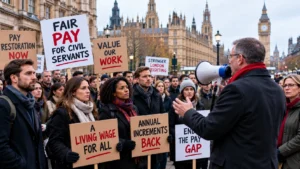
The 3.5% national figure has not ended the wider debate over Civil Service pay.
One major Civil Service union continues to seek a 10% consolidated increase, an £18 minimum hourly rate, pay restoration, stronger London weighting and automatic progression.
Another Civil Service workforce survey found that 97% of respondents thought the system of more than 200 bargaining units did not work, while 93% supported reintroducing annual increments.
The same survey showed strong concern about inconsistent pay for comparable work across departments.
These are union positions and member survey findings rather than confirmed changes to government pay policy.
Do Scotland, Wales and Northern Ireland Use the Same Civil Service Pay Remit?
Not in every case.
The 2026/27 UK delegated remit applies to organisations falling within its stated scope, while devolved governments operate separate pay-setting arrangements.
Employees working for devolved administrations should therefore check the relevant national employer framework rather than assuming the UK departmental 3.5% remit determines their salary.
What Happens Next With Civil Service Pay in 2026?
The next important deadline is 31 October 2026, when departments seeking exceptional pay flexibility must submit their business cases.
Departments considering such cases are encouraged to submit earlier because applications arriving close to the deadline may take longer to assess.
Interim awards can sometimes be made while a flexibility case is being considered, but approval is required.
For employees, the most important information will continue to come from departmental pay announcements.
The national 3.5% IRC establishes the framework, but actual increases, implementation dates, back pay, allowances and conditions can differ significantly between organisations.
Conclusion
The civil service pay rise 2026 is no longer simply a story about a 3.5% national figure.
The 3.5% IRC remains the core limit for most delegated departments, but departmental outcomes now show how differently the framework can work in practice.
HMRC has proposed increases ranging from 3.30% to 4.43% depending on grade and location, the Home Office is operating a multi-year arrangement with a 5.5% minimum for 2026/27, and some workforces follow completely separate pay mechanisms.
Pay compression, settlement dates, specialist allowances, pension contribution thresholds and progression are also increasingly important parts of the overall picture.
For individual civil servants, the most reliable figure is therefore the one confirmed by their own employer.
The national remit controls the overall framework, while departmental implementation ultimately determines what appears in each employee’s salary and payslip.
FAQs About the Civil Service Pay Rise 2026
Is the Civil Service pay rise 2026 confirmed?
Yes. The 2026/27 delegated pay framework sets a maximum 3.5% Increase to Remuneration Cost for organisations covered by the standard remit. It is not a guaranteed 3.5% increase for every employee.
Will every civil servant get 3.5%?
No. Departments can distribute their pay budgets according to grade structures, workforce requirements and approved reforms. Individual awards can therefore be above or below 3.5%.
Will the Civil Service pay rise be backdated?
It can be. This depends on the department’s settlement date and implementation arrangements. Where a new rate is implemented after its effective settlement date, arrears may be included in a later salary payment.
Can departments pay more than 3.5%?
Yes, but only through approved routes or existing arrangements outside the normal remit. Exceptional flexibility normally requires a business case showing the workforce need, affordability, reform and associated savings.
What is the deadline for Civil Service pay-flexibility applications?
Departments have until 31 October 2026 to submit 2026/27 pay-flexibility business cases.
Is the Home Office limited to 3.5% in 2026/27?
No. Staff covered by its accepted multi-year arrangement have a guaranteed minimum uplift of 5.5% for 2026/27, although individual outcomes can vary.






[…] but members should avoid planning a retirement decision around an assumed launch day until Civil Service Pensions confirms that the tool is […]